
.svg)

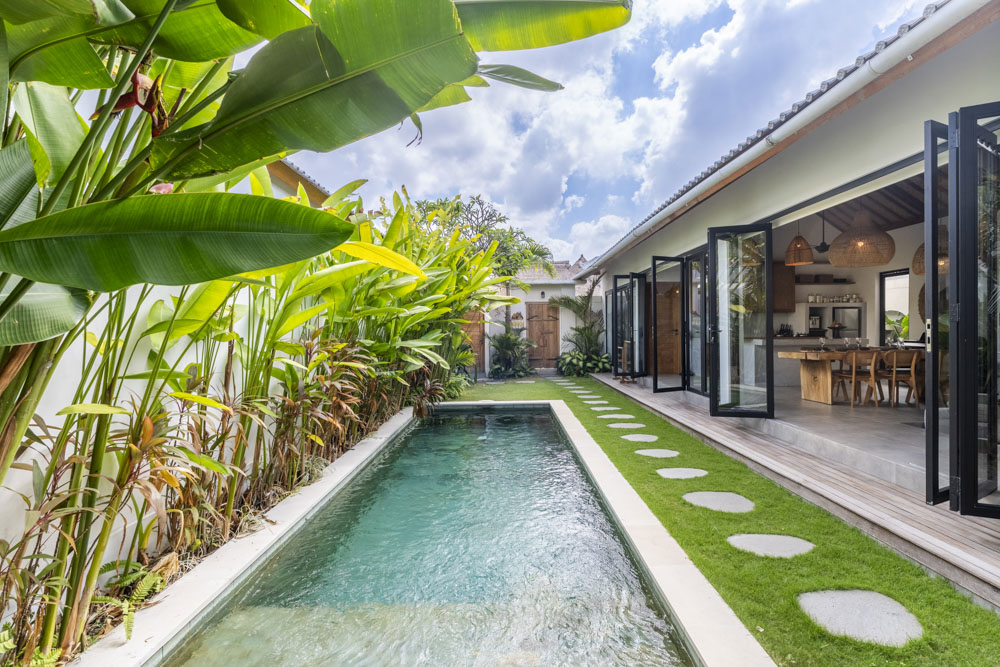
Under $150,000, you are not buying a finished villa in Canggu, Seminyak, or Uluwatu's established core. What you are realistically looking at is an off-plan unit, a co-ownership share in a larger villa, or land in an emerging area — each with a different risk profile and a different wait before any income arrives.
That's not a discouraging answer. Entry-level Bali investment works for the right buyer. But it works far better when you go in knowing what the number actually reaches, so this piece sets out the real price map first and the honest trade-offs second.
The Reality Check — Where $150K Lands You
Land price per square metre is the single most useful number in the Bali market, because it explains everything else.
For finished villas, the island's mid-market sits well above the $150K line. Most completed villas across the main areas transact somewhere between $250,000 and $600,000, with prime and luxury stock running from $700,000 into the millions. Emerging areas are where the entry-level stock genuinely lives — villas there start around $100,000 and run to $600,000 depending on size and spec.
Uluwatu is a partial exception worth understanding. Our own listings start from around $150,000 for off-plan cliff-top builds, with the bulk of completed inventory sitting between $250,000 and $600,000 — the detail is in our Uluwatu villas guide. So sub-$150K here is real, but thin, and almost always means off-plan or a compact one-bedroom unit rather than a finished multi-bedroom villa.
The build-cost arithmetic most listings don't show you. Island median build cost runs around $1,335 per m², and turnkey land-plus-build in the southern hotspots typically lands between $1,000 and $2,000 per m². Run that through a modest project: a 200 m² plot in Uluwatu at $400/m² is $80,000 of land, and a small 100 m² villa on it is roughly another $133,000. That's $213,000 before permits, furniture, or fees. Even in an emerging area at $200/m² land, the same build puts you around $173,000.
This is the single most important number in this article: buying land and building on it is very rarely a sub-$150K route. It's a $200K+ route that starts with a sub-$150K land purchase.
What's Actually Available Under $150K
1. Off-plan and pre-construction units
What it is: you buy before or during construction, usually paying a deposit followed by instalments tied to build milestones over 12–24 months.
Why the price is lower: you're carrying the developer's delivery risk and forgoing income during the build. That discount is the compensation for both.
Typical structure: leasehold, most commonly 25–30 year terms. Our leasehold guide covers what to check on term and renewal.
The honest trade-off: no rental income until handover, and a real chance of delay. You are also buying from a rendering. Verify the developer's completed track record — finished, delivered, occupied projects — not their portfolio of visualisations.
2. Fractional or co-ownership shares
What it is: you buy a share, commonly an eighth, in a company that owns a villa. Entry points typically run from $20,000–$30,000 per share, with defined personal-use nights and a proportional claim on rental income.
The distinction that matters: genuine co-ownership means equity in the entity holding the property, so you're entitled to income distributions and a share of any capital gain on sale. A timeshare is a contractual use-right with none of that. These are marketed with similar language and are legally very different things.
The honest trade-off: you don't control the asset, the exit, or the management decisions. Operator risk is real — the villa management market has consolidated through 2026 and smaller operators are under financial pressure. Ask what happens to your share if the operator fails, and get the answer in writing.
3. Land in emerging areas
What it is: raw or semi-developed plots in Tabanan, Seseh, Cemagi, Buduk, or parts of north Bali, at under $250/m².
Why it's attractive: it's the cheapest genuine entry point and the most land per dollar on the island.
The honest trade-off: as the arithmetic above shows, land alone doesn't produce income — building does, and building takes you past $150K. If your plan is to hold and sell, you're making a pure appreciation bet with holding costs and no cashflow. Land also needs exactly the same due diligence as any purchase: zoning, certificate type, access, encumbrances. Cheap land in a green zone isn't a bargain, it's an unbuildable liability.
The Trade-Offs Nobody Puts in the Brochure
Gross yield is not net yield. Prime-area gross yields are widely quoted at 10–18%. Net is a different number: roughly 4–6% self-managed, and 10–15% with professional management. Entry-level properties are far more likely to be self-managed in their first years, which puts you at the bottom of that range. Any listing quoting a single headline yield figure without saying gross or net is telling you something about the seller.
Occupancy tops out lower than models assume. Prime areas run 70–85%; the island average is closer to 65%. Nobody achieves 100%, and Nyepi shuts the entire island down for a day each year.
Emerging areas ramp up slowly. Infrastructure, road access, and tourist footfall in Tabanan or north Bali are genuinely still developing. That's precisely why the land is cheap. Price in years, not quarters, before rental demand matures — and if the thesis depends on a future airport or road, treat that as speculation rather than a plan.
Off-plan risk is delivery risk. Delays, spec changes, and developers who run out of capital mid-project are the failure modes. Instalments tied to verified construction milestones, held properly, are your main protection.
Zoning still governs everything. If rental income is part of the plan, the property needs tourism zoning — screen it on the government's RDTR Interaktif map and confirm in writing. The framework sits in Perda Provinsi Bali No. 2/2023. A residential-zone villa cannot be licensed for short-term rental later, at any price.
Our post on what nobody mentions on social media about investing in Bali goes further into the gap between the marketing and the operating reality.
How to Vet an Entry-Level Deal
- Confirm zoning matches your intended use before anything else. Pink for eventual short-term rental, not green.
- For off-plan: ask for the developer's completed and delivered projects, visit one, and speak to an owner. Check that instalments are tied to inspected construction milestones.
- For co-ownership: get the legal structure in writing. Who holds title? What class of shares do you hold? How is rental income calculated and distributed? What's the resale mechanism, and has anyone actually exited yet?
- For land: run the full certificate, access, and encumbrance checks, and get a written zoning confirmation rather than the agent's word.
- Get an independent valuation. The sub-$150K segment marketed to first-time foreign buyers is where inflated asking prices are most common, precisely because these buyers have the least local reference data.
- Budget the closing costs. Depending on structure, they add roughly 6–12% on top of the purchase price. On a $140K purchase that's $8,000–$17,000 you need available and haven't yet counted.
Our legal team runs these checks independently of the sale side, which is the arrangement you want.
Is Sub-$150K Actually a Good Investment?
It can be — for a specific kind of buyer.
It works if you're patient, comfortable holding through an emerging-area ramp-up or a construction period, willing to be hands-on with management early, and treating this as a five-to-ten-year position rather than an income stream starting next quarter.
It works less well if you need rental income soon, want a turnkey experience, are relying on quoted gross yields to service borrowing, or expect the liquidity of a mature market on exit. Resale in emerging areas is slower and thinner than in Canggu or the Bukit.
The more useful question is usually not "what can I get for $150K" but "where should $150K go." A compact off-plan unit in an established, tourism-zoned area often outperforms a larger plot somewhere the market hasn't arrived yet — because the first one has a licensing path and a rental market, and the second one has a thesis.
FAQ
What can $150,000 actually buy in Bali right now? Realistically: an off-plan or compact one-bedroom leasehold unit, a co-ownership share in a larger villa, or a land plot in an emerging area such as Tabanan, Seseh, or Cemagi. Finished multi-bedroom villas in Canggu, Seminyak, and Uluwatu's established core sit well above this budget, with most completed stock between $250,000 and $600,000.
Is off-plan property in Bali risky? It carries delivery risk that finished property doesn't — delays, specification changes, and developer failure. It's manageable if you verify the developer's completed projects rather than their renderings, tie instalments to inspected construction milestones, and treat the discount as compensation for risk rather than a bargain.
What is co-ownership or fractional property in Bali? You buy a share, typically an eighth, in a company that owns the villa, giving you defined personal-use nights and a proportional share of rental income and any capital gain. It differs fundamentally from a timeshare, which grants only a use-right with no equity. Verify the legal structure and the resale mechanism before committing.
Are emerging areas like Tabanan or Seseh a good investment? They offer the most land per dollar, at under $250/m², but on a longer horizon. Infrastructure and tourist demand are still developing, so rental income ramps slowly and resale is thinner. They suit land-banking and patient capital rather than near-term cashflow.
What yield can I realistically expect on an entry-level Bali property? Expect 4–6% net if you self-manage, which most entry-level owners do at first, and 10–15% net only with professional management on a well-located, properly licensed property. Headline gross figures of 10–18% apply to prime areas before costs, and should not be used for planning.
Where to Start
Under $150,000, the three real categories are off-plan, co-ownership, and emerging-area land. Each one trades something — time, control, or income — for the lower entry price. Knowing which trade you're making is most of the decision.
If you want to see what this budget reaches in Uluwatu specifically, our under $200K selection is the place to start, and the full current listings show where the next tier up sits. Or talk to us about where the budget should go — the area question usually matters more than the price question at this level.

.avif)
